Sorry for the long silence. I haven't been steaking for a while; I suppose that will be a plus in my "grade book" of health when I face my maker in the end. Well, the drinking won't help, but the minus-red meat might.
Anyway, a comment on how it all went, this Kobe deal, and why I am totally disillusioned: number one, fuck Kobe steak. It's all a fucking myth. People, in all my explorations, I've found that the so-called Kobe steak is probably a wholly fabricated article, like "Genuine" Pacific salmon or whatever you wish to insert in the blanks. These assholes can invent whatever they want to describe the product. Genuine Kobe beef is not only not from Kobe, but the whole story about how it got to your plate is a labyrinthine mystery worthy of Agatha Christie. Chances are, it's not Japanese, it wasn't massaged with beer, and it's an entire crock of shit.
So never, NEVER, trust anyone when they say it's genuine Kobe beef. I've been there, baby, and it wasn't from Kobe, and it is doubtful that the entire appellation has any meaning at all.
For the record, the "Kobe beef" that I paid 200 fucking dollars for at Atlantique was absolutely terrible, riddled with inedible gouts of fat and just a vast pool of regret that I live with to this day.
Enough with the Kobe beef experiments; having gone directly to the source in Japan, I can safely say that it's all a bunch of fucking hype.
Tuesday, August 8, 2006

Friday, June 30, 2006
Atlantique Kobes

Well, I must say I'm disappointed. No, that's not strong enough. Pissed off? Maybe. I went in to get my Kobe steaks at Atlantique today. They were part of a large (3.8 kg/8.3 lbs) chunk of meat that had been vacuum packed. Werner the counter guy informed me that he would be charging $120/kg. That is about CDN$54/lb. Mighty steep. Upon looking at the cut, I immediately noticed that, unlike the cuts I'd seen in Japan, this wasn't heavily marbled — no, all the fat was in two huge veins running throught the entire cut.
I asked him to make me three one-inch steaks and then trim them. Of course, he acted offended, and told me that the fat was the best part and most of it would render off. Well, to him, the fat was just as golden as the rest of the steaks, obviously. I, not being a confrontationalist, kept it to myself and let him slice it up.
The three steaks came to — get this — $200. Upon looking at them — judge for youyrself — I calculate fully one third of them is just a big slab of inedible fat. Umm, that's $66 worth of fat . . . a new record.
The most expensive fat I've ever bought.
I'll let you know how they were, but they'd better be good. Very, very good.
Friday, June 23, 2006
Holy Grail, Cracked
Sorry for the delay on this posting, but I guess I was too blown away to tackle it right away. Here is the infamous $45 steak that I tracked down at Kintetsu department store in Nara.
It can't weigh much more than 8 oz., so that easily makes it the most expensive steak I have ever eaten at $90/lb. Remember that this is not a steak ordered in a restaurant, where they'd easily mark it up by a third, if not a half, to make the price $60 or almost $70.
It was a Matsuzaka steak. Matsuzaka beef is grown in Mie prefecture, which is very close to Hyogo prefecture (where Kobe is situated.) The cattle — Tajima — is the same breed.
How was this monster of monster steaks? Well, the small size alone was disappointing. I would have preferred to have had it grilled over charcoal but that option wasn't available; I cooked it simply on a gas stove in butter with some shaved garlic to rare, no sauce.
It was indeed melt-in-your-mouth tender, but I've had lots of steaks like that. Bottom line is that the Holy Grail was a bust — and that the most expensive steak on Earth is not necessarily the best one.
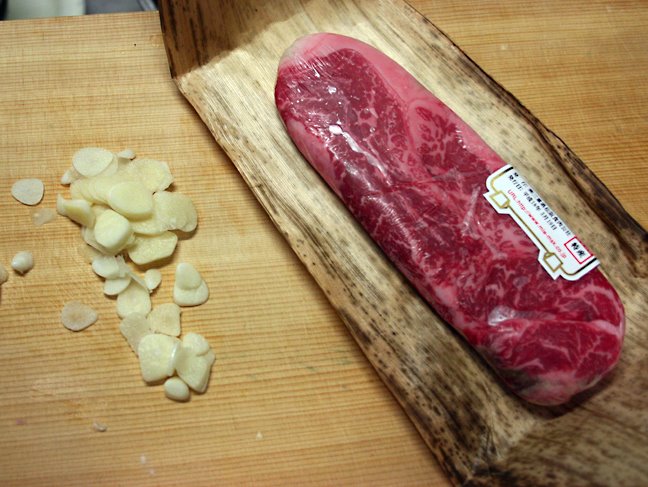
It can't weigh much more than 8 oz., so that easily makes it the most expensive steak I have ever eaten at $90/lb. Remember that this is not a steak ordered in a restaurant, where they'd easily mark it up by a third, if not a half, to make the price $60 or almost $70.
It was a Matsuzaka steak. Matsuzaka beef is grown in Mie prefecture, which is very close to Hyogo prefecture (where Kobe is situated.) The cattle — Tajima — is the same breed.
How was this monster of monster steaks? Well, the small size alone was disappointing. I would have preferred to have had it grilled over charcoal but that option wasn't available; I cooked it simply on a gas stove in butter with some shaved garlic to rare, no sauce.
It was indeed melt-in-your-mouth tender, but I've had lots of steaks like that. Bottom line is that the Holy Grail was a bust — and that the most expensive steak on Earth is not necessarily the best one.
Whole Side of Kobe From The Germans
Okay, I keep calling them Germans and they're Austrian so I know that's not fair, but I have placed on order with Werner at Atlantique in Cote des Neiges a large slab of Kobe beef for next Friday. I have no idea what it is going to cost, but I know that it will be frighteningly expensive, probably more so than in California — but not as expensive as Japan.
Monday, June 5, 2006
The End is Near
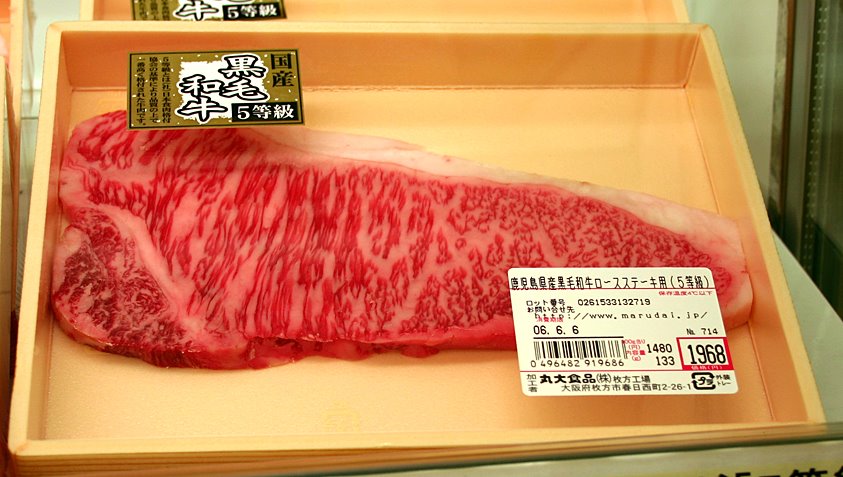
Jack Sprat would not be a great meat eater here in Japan. Take a look at these specimens found at the local supermarket; “marbled” is not an appropriate term for these babies. There’s almost less meat than fat on them. This one (below) at 1,968 yen, is about US$18. You’ll note that it’s only about a third of an inch thick—one minute on both sides and it’d be medium rare. It’s called a “Kuro-ge” (“Black hair,” referring to the color of the cattle) “Roast steak” and comes from Kagoshima, which is all the way in the south of Japan.

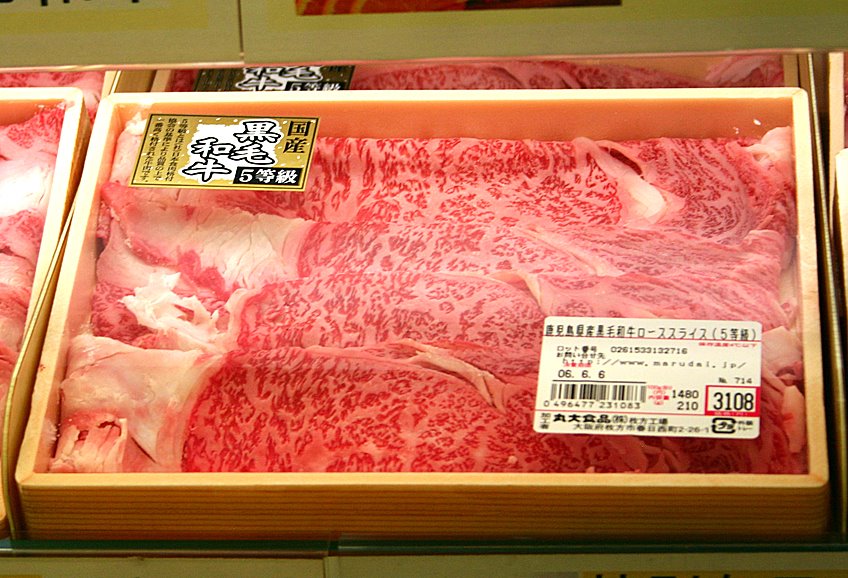
These specimens below are also from Kagoshima and are called “Roast Slices.” It’s anyone’s guess as to how you’re supposed to prepare them. I’m not going to find out, since I didn’t buy them.

No, I didn’t buy them. Instead, I bought quite possibly the most expensive steak I have ever seen in the entire world, today; a fairly small piece of meat that cost exactly US$44.45. I videoed the whole thing and will provide photos upon my return to Montreal.
I’m going to have to eat it here, as they don’t seem to understand freezing and vacuum-packing, but perhaps it’s for the best, as it’s a long, long way home.
Report to follow.
These specimens below are also from Kagoshima and are called “Roast Slices.” It’s anyone’s guess as to how you’re supposed to prepare them. I’m not going to find out, since I didn’t buy them.
No, I didn’t buy them. Instead, I bought quite possibly the most expensive steak I have ever seen in the entire world, today; a fairly small piece of meat that cost exactly US$44.45. I videoed the whole thing and will provide photos upon my return to Montreal.
I’m going to have to eat it here, as they don’t seem to understand freezing and vacuum-packing, but perhaps it’s for the best, as it’s a long, long way home.
Report to follow.
Monday, May 29, 2006
Kobe in Montreal
Werner at Atlantique in Cote des Neiges has informed me that he will soon be able to get Kobe beef. "Now that there's an embargo on Canadian beef because of Mad Cow, the stuff destined for Japan (read: the "Kobe" steak that's actually raised here, then sent to Japan for finishing) has been rerouted to distributors here in Canada."
He warned me that it will be expensive. $50 a pound? Maybe, he said. "You'd be better off buying a whole cut — say, half a loin, which we could cut into steaks and then vacuum-pack. Then you could freeze them. I could give you a lower price because I'm getting rid of them so quickly."
But he was defiant about his own steaks. "I trim them to perfection, then dry-age them for five weeks. You just can't get a better steak in Montreal." The Steakathon seemed to prove he was partially correct.
I'm off to Japan on Thursday. I'm not sure I can actually get some Kobe steaks but I'll film everything and do my damndest to return with something. Let's see if I can pull off yet another trip in First Class!
He warned me that it will be expensive. $50 a pound? Maybe, he said. "You'd be better off buying a whole cut — say, half a loin, which we could cut into steaks and then vacuum-pack. Then you could freeze them. I could give you a lower price because I'm getting rid of them so quickly."
But he was defiant about his own steaks. "I trim them to perfection, then dry-age them for five weeks. You just can't get a better steak in Montreal." The Steakathon seemed to prove he was partially correct.
I'm off to Japan on Thursday. I'm not sure I can actually get some Kobe steaks but I'll film everything and do my damndest to return with something. Let's see if I can pull off yet another trip in First Class!
Friday, May 19, 2006
Stir-Fried Thai-Style Beef with Chiles and Shallots
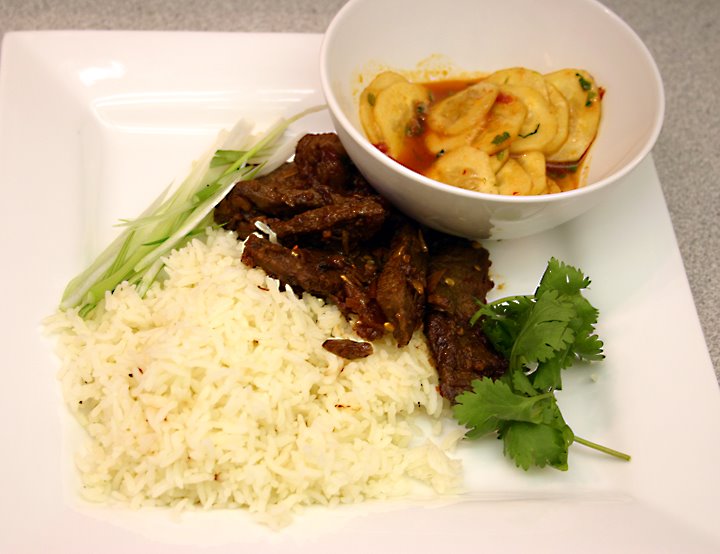
with Spicy Marinated Cucumber Salad and Jasmine Rice
The key to this dish is twofold: first, get Thai basil. It is a cross between mint and fennel — the taste is indescribable. Second, get tamarind concentrate (or paste.) It gives an authentic touch that is difficult to duplicate with substitutes. Palm sugar is good, but brown will do. Piquin chiles are good, but serrano or even jalapeños are okay.
Serves 4 with rice
Beef and Marinade
1 T tamarind concentrate
1/2 tsp. ground white pepper
1 tsp. palm sugar
2 T fish sauce (Nam Pla)
1/4 cup chopped cilantro
1 T minced garlic
2 T lime juice
2 pounds Boston or New York steak , trimmed and cut into 1/4-inch-thick strips
Stir-Fry
2 T Nam Pla
2 T rice vinegar
2 T water
1 T palm sugar
1 T Asian chili-garlic paste
4 medium cloves garlic , minced (about 2 tablespoons)
3 T vegetable oil
10 Thai bird chiles (piquin), halved, seeds and ribs removed, chiles cut crosswise 1/8 inch thick
3 medium shallots , trimmed of ends, peeled, quartered lengthwise, and layers separated
1/2 cup Thai purple basil, in chiffonade
1/2 cup fresh cilantro leaves, chopped coarsely
1/3 cup chopped unsalted roasted peanuts
Lime wedges for serving
1. For the beef and marinade: Combine marinade ingredients in large bowl. Add beef, toss well to combine; marinate as long as possible. Overnight is good, minimum is one hour.
2. For the stir-fry: In small bowl, stir together fish sauce, vinegar, water, palm sugar, and chili-garlic paste until sugar dissolves; set aside. In small bowl, mix garlic with 1 tsp. oil; set aside. Heat 2 tsp. oil in 12-inch nonstick skillet over high heat until smoking; add one-third of beef to skillet in even layer. Cook, without stirring, until well browned, about 2 minutes, then stir and continue cooking until beef is browned around edges and no longer pink in the center, about 30 seconds. Transfer beef to medium bowl. Repeat with additional oil and remaining meat in 2 more batches.
3. After transferring last batch of beef to bowl, reduce heat to medium; add remaining 2 tsp. oil to now-empty skillet and swirl to coat. Add chiles and shallots and cook, stirring frequently, until beginning to soften, 3 to 4 minutes. Push chile-shallot mixture to sides of skillet to clear center; add garlic to clearing and cook, mashing mixture with spoon, until fragrant, about 15 seconds. Stir to combine garlic with chile-shallot mixture. Add fish sauce mixture to skillet; increase heat to high and cook until slightly reduced and thickened, about 30 seconds. Return beef and any accumulated juices to skillet, toss well to combine and coat with sauce, stir in half of mint and cilantro; serve immediately, sprinkling individual servings with portion of peanuts and remaining herbs, and passing lime wedges separately.
Spicy Cucumber Salad
1/2 cucumber, peeled and sliced thinly
1 tsp. sesame oil
1 tsp. sambal oelek, sriracha or garlic-chile paste
dash lime juice
Combine thoroughly, marinate for a couple of hours in refrigerator. Serve.
Jasmine Rice
2 cups jasmine rice
2 1/3 cups chicken broth
Stick cinnamon
3 cloves
3 cardamom pods
Ghee (clarified butter)
Wash rice until water runs clear. Soak in water for 2 hours, drain. In large sauté pan on medium heat, melt 2 tablespoons ghee or vegetable oil. Fry spices for a couple of minutes. Add drained rice. Stirring constantly, fry for about five minutes, or until glassy. Add hot chicken broth, stir to combine, reduce heat to minimum, cover with aluminum foil and pan lid. Let steam for 18 minutes or so, remove from heat and let rest for 10 more minutes. Remove lid. Remove whole spices and fluff up. Serve.
Subscribe to:
Posts (Atom)